



Stopping the “Burnt Outside, Raw Inside” Nightmare
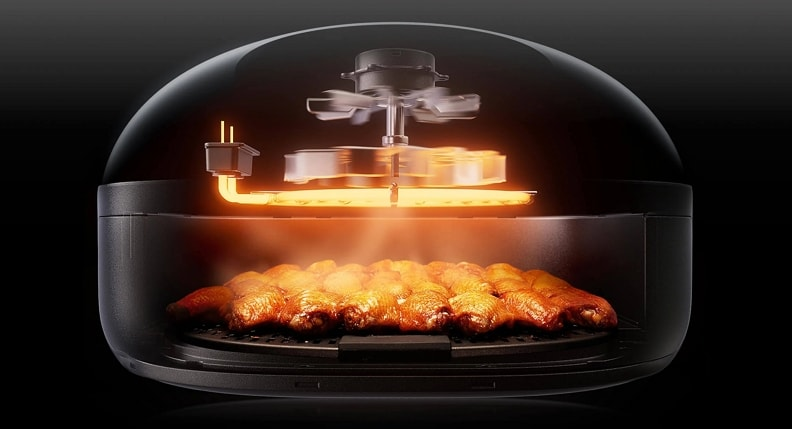
We’ve all been there. You’re cooking a thick cut of meat in a pizza oven, and it looks perfect on the outside—beautifully charred, great color. Then you cut into it, and the center is basically raw. It’s frustrating. To fix this, we started using 800W shortwave infrared (IR) heaters. Here is the secret: convection heat just pushes hot air around, but IR radiation actually sinks into the meat. It doesn’t just sit on the surface; it goes deep.
How it actually works
Think of an 800W IR lamp as a way to vibrate the water molecules deep inside the meat. Instead of waiting for the heat to slowly crawl from the crust to the center, you’re cooking from the inside and outside at the same time. Now, you might wonder why we stuck with 800W. Well, it’s a balancing act. If you cram too much power into a small oven, you’ll just torch the surface before the middle even gets warm. 800W is the “sweet spot” for most standard oven sizes.
Getting the temperature just right
One of the best things about IR heaters is that they have almost zero lag. The second you kill the power, the heat stops. No lingering warmth, no waiting. But because they’re so fast, they can overshoot your target temperature if you aren’t careful. To stop that from happening, I recommend using a PID controller and a fast K-type thermocouple. If you wire those into a PWM (Pulse Width Modulation) circuit, you can keep your temp steady within about 1°C. This is huge because it keeps the meat from seizing up, which usually happens when you hit it with sudden, violent temperature spikes.
A few things to watch out for
It’s not all plug-and-play. High-intensity IR is tough on the quartz glass. **Keep your lamps away from grease.**If a drop of oil hits that glass, it creates a hot spot. That’s a one-way ticket to a cracked tube. And if you’re adding these to an old oven, please check your power draw. A few 800W elements will trip a standard 15A circuit faster than you can blink. Balance your load across phases so you don’t blow a fuse mid-dinner. Also, don’t use cheap wires. Get some high-temperature silicone or fiberglass sleeved leads. Standard insulation will just melt, and that’s a mess nobody wants.